
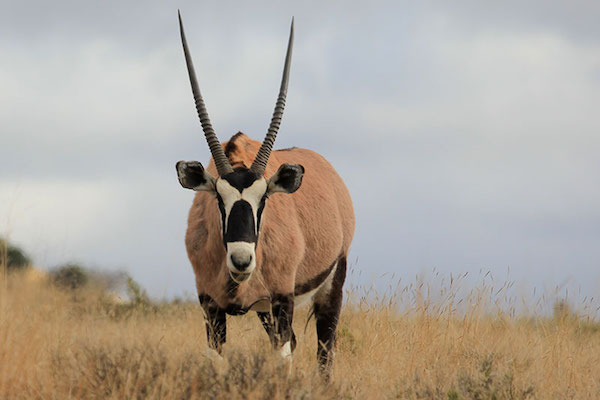
GEMSBOK
Gemsbok are large bovids with very thick, muscular necks, covered in dense, inelastic skin. Oryx gazella is the largest of the Oryx species. Gemsbok measure 115 to 125 cm high at the shoulder, and have total body lengths between 180 and 195 cm. Females weigh from 180 to 225 kg, whereas males are slightly larger, weighing between 180 and 240 kg. The slightly curved, ringed horns range from 60 to 150 cm in length. The horns of females are often shorter and more slender than those of males.
Black markings on the face extend down from the base of the horns to above the muzzle, and sweep back in stripes over the eyes and cheeks. Black continues down the neck and around the underbody, forming bands around all four legs. A stripe also runs up the spine, starting at the tip of the tail and ending at a short thick mane of black. There are black markings on the front of all four legs. The lower portion of the legs, muzzle, and underbelly are all white, whereas the body and neck are a gray or tan color. In instances of high productivity grazing, fat deposits under the skin become noticeable.
The Gemsbok is a large antelope of striking appearance with long, spearlike horns. It has a thick, horselike neck with a short mane and a compact, muscular body. A defined pattern of black markings that contrast with the white face and fawn-colored body are prominently displayed in dominance rituals to emphasize the length of horns and strength of the shoulder. Inidividuals in northern populations have characteristic black tufts on the ears and are generally darker in color with thinner black markings than are individuals from southern populations. Gemsbok are able to increase their body temperature to 45 degrees from 35.7 degrees C in order to delay evaporative cooling.
The most distinctive features of the heavily built gemsbok are its long, rapier-shaped horns and striking black and white facial markings. The head is marked with black triangular patches and broad black stripes that extend from the base of the horns over the eyes to the cheeks. A ring of black encircles the throat and runs down the neck to the chest. The ears end in a black tip (a black tassel hangs from the ear tip of the fringe-eared oryx). A narrow black stripe runs along the spine, and another one separates the lower flank from the white underparts of the body. The white forelegs have a black ring above the knee and a black patch below. The black tail tassel reaches to the hocks. The oryx's ringed horns are up to 30 inches long, making them formidable weapons. The female's horns are often longer and thinner than the male's.
WHERE WILL YOU FIND THEM
You will find the elephants at pen E23, close to the amphitheatre.