
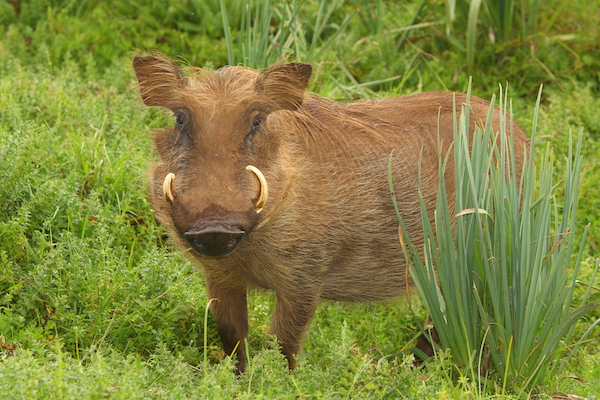
WARTHOG
Warthogs, as one might guess from the name, are members of the Swine family and are related to pigs, boars and hogs. And as the name also suggests, warthogs have patches on their faces that look like warts, but are just thick growths of skin. These patches act as padding for when males fight during mating season. Like their relatives, warthogs are plump, hooved animals with large nostrils at the end of the snout. They have little fur, except for a mane that goes down the spine to the middle of the back, according to the Animal Diversity Web (ADW). Their tails also end with a tuft of hair.
They have large teeth or tusks. Common warthogs have two upper and four to six lower incisors, according to ADW, while desert warthogs lack incisors. The upper tusks grow up to 10 or 11 inches (25 to 30 centimeters) long, according to the San Diego Zoo. From hooves to shoulders, warthogs are around 30 inches (36 centimeters) tall and 35 to 59 inches (89 to 150 cm) long from shoulders to rump. They weigh a hefty 120 to 250 lbs. (54 to 113 kilograms). Common warthogs are slightly larger than desert warthogs.
Warthogs are often perceived as vicious animals that attack and eat prey. Actually, warthogs are herbivores, which means they eat vegetation, according to ADW. A warthog's diet includes roots, berries, bark, bulbs, grass and plants. During times of scarcity, warthogs may eat meat, but they don't hunt. They munch on dead animals, worms or bugs they find as they forage. Warthogs can run up to 30 mph (48 km/h). Their speed helps them outrun predators. They zoom right to their dens and enter rear first, with their tusks sticking out of the entrance for added security.
During the rare times a warthog decides to face an attacker instead of hiding in their den, it will slash at the attacker with its tusks and bite with its sharp teeth. Oxpeckers and other birds ride on warthogs and eat insects off their bodies. Warthogs will also wallow in mud to get rid of insects and to cool down on a hot day. Like pigs, warthogs don't have sweat glands to cool themselves. Warthogs also have padding on their knees. They often kneel to eat lower grasses or to slurp up a bug.In a dry season, these animals can go months without water, according to National Geographic.
WHERE WILL YOU FIND THEM
You will find the elephants at pen E31, close to the amphitheatre.